Latest Posts

Blue Hill at Stone Barns Tells a Beautiful Story. Former Employees Say It’s Too Good to Be True.

Illustration of a hand holding up a pair of rose-colored glasses, the view of a building turns pinker within the lens.

Blue Hill at Stone Barns’ alluring story — that a fine dining restaurant could be a model for changing the world — seduced diners, would-be employees, and thought leaders alike. But former employees say that narrative often obscured a more complicated reality.

This story contains a detailed account of a sexual assault.

In November 2013, a 22-year-old cook named John Schaible arrived in Pocantico Hills, New York, to work at Blue Hill at Stone Barns. Located on a working farm that was once part of a sprawling Rockefeller estate, the restaurant is a beacon of the sustainable food movement. Schaible kept a notebook in his back pocket to write down everything he learned: how sheep-grazing patterns affect flavor, the proper way to butcher old dairy cattle. There was so much to take in, especially from the head chef, Dan Barber.

No chef has shaped the 21st-century conversation about the connections between agriculture, cuisine, ecology, health, and climate change more profoundly than Barber. Hailed as a “philosopher chef” and a “prophet of the soil,” he argues that the choice between a delicious meal and a sustainable future is a false one: Regenerative farming can replenish the land, nourish our bodies, and produce super-delicious squash. If chefs work directly with farmers, he preaches, they can create a cuisine so delicious that Americans will ditch Big Ag forever. This hopeful message, which Barber delivers from behind the pass and onstage at TED, has earned him the devotion of countless fellow luminaries, from Ruth Reichl to the Obamas.

By May 2014, when a camera crew from Chef’s Table arrived to shoot an episode dedicated to Barber, Schaible’s enthusiasm was gone. That spring, he alleges, he was sexually assaulted by a member of the kitchen management, and in the aftermath, was devastated by how the restaurant’s leadership, including Barber, handled his allegation. “I only had four or five months to really be enamored with everything until my world flipped on me,” he says. The Chef’s Table episode, in which he appears in the background hustling on the line, is painful for him to watch. “Last year, I showed my partner the scenes I was in, and he was ecstatic, ‘Cool, my boyfriend’s on Netflix!’ All I could think about is how sad it is. I know what I was going through and know how much I hurt.”

Schaible is one of nearly 20 former employees who’ve told me that they arrived at Blue Hill at Stone Barns filled with passion and ambition, only to leave drained and disillusioned — or deeply scarred — by their experiences there. As Barber found fame by advocating for a culinary revolution, former cooks, servers, and managers say that conditions at his own restaurant could be brutal, rife with grinding pressure and explosions of anger. Many of these former employees say that they endured the working conditions at Blue Hill at Stone Barns because they believed in its mission. But then, they say, they came to realize that the story told by the restaurant — that a fine dining establishment can create a blueprint for transforming the food system — is essentially a fantasy. While staff did work with local, seasonal, unique ingredients, servers and cooks alike say they grew uncomfortable telling stories about some of the restaurant’s sourcing and preparation practices, including for a number of its signature dishes, which they considered misleading.

Over the course of reporting this story, I have spoken to more than 45 people, including more than 20 former Blue Hill at Stone Barns employees whose names were provided by the restaurant or who were otherwise encouraged to contact me. Numerous sources asked to be anonymous, fearful of the enormous reach and influence of Dan Barber. Repeated requests to speak directly with the leadership of Blue Hill at Stone Barns were denied. While this story was being reported, Blue Hill and its leadership — Dan Barber, David Barber, and Laureen Barber — retained the prominent Washington, D.C.-based crisis PR firm Trident DMG, as well as Clare Locke, a high-profile defamation law firm; all responses and quotations from Blue Hill and the Barbers came through a spokesperson.

Barber often tells the press that the goal of his restaurant is to be a model for how chefs can create a new style of eating that supports local farms, “a model that can be replicated anywhere.” But if workers say that the process of creating his transformational cuisine was exhausting and demoralizing — that it is, one might say, unsustainable — then what exactly is Blue Hill at Stone Barns modeling? And if Dan Barber, who can command hundreds of dollars for dinner on a farm funded by the Rockefellers, cannot fully live up to the ideals he says the rest of the world must aspire to, who can?


The Stone Barns Center for Food and Agriculture, a nonprofit regenerative farm and educational center, opened in 2004 on the site of a former dairy farm. Connected to it was an “upmarket” restaurant intended to be a platform for — and to financially support — the center’s work advocating sustainable community farming. The chef chosen to run it, Dan Barber, had trained in France and at California restaurants Chez Panisse and Campanile, both famed for their dedication to working with seasonal ingredients from small farms. His own restaurant, Blue Hill in Manhattan — named for his family farm in Massachusetts — became an icon of farmer-centric cooking when whole-animal butchering and kohlrabi pickling were just a twinkle in Brooklyn’s eye. At Blue Hill at Stone Barns, he aspired to transcend farm-to-table with a more holistic approach, one where farmers collaborate with chefs to breed for flavor and chefs cook what’s best for the ecology of local farms.

According to restaurant critics and well-heeled diners, Barber not only succeeded, he triumphed. Blue Hill at Stone Barns has been showered with raves from national publications, two Michelin stars, and a hard-won spot in the upper echelons of the World’s 50 Best, with Tesla-driving hedge funders, corporate execs, and Michelin list-checkers routinely pilgrimaging 25 miles north of New York City to “forage” for mushroom tartlets from under a pile of oak leaves, sausages made from duck pastured on-site, and whole-grain mini-brioches baked with wheat developed by — and named for — Barber, served with freshly churned butter from one of the Barber family cows. The cost of that meal has steadily climbed over the years. In 2019, Blue Hill at Stone Barns’ most recent full year of operation, it started at $258 per person; tickets to dinner currently cost between $348 and $398.

More than any specific dish though, what brought people to nibble on tiny, perfect radishes was the story that Blue Hill at Stone Barns told: how each ingredient, and the way it was produced, promises a profoundly better way of farming, eating, and living. “It’s about what the radish represents,” Barber said in Chef’s Table. “It has to add up to something larger than a plate of food.”

A breaded carrot plated on a dish with sauce. Neilson Barnard/Getty Images for the New York Times
The carrot cutlet, a signature Dan Barber dish that represents the “Third Plate,” served at an event at in 2014.

Aspiring cooks from across the country were also drawn to Pocantico Hills with a version of that story: the prospect of an unparalleled education in working with farmers and a singular opportunity to reforge American cuisine. When Emma Meigneux was hired as an extern in 2016, she says, it was a dream come true. “It was the first time I saw windows in a kitchen, which was something I’d never imagined,” she says. “I thought it would be so much different than the other restaurants I’d worked in.”

But former cooks, servers, managers, and externs told me Barber’s drive to repair the food system largely did not extend to the arena over which he arguably had the most control — the working conditions of his own staff. They say that the kitchen culture at Blue Hill at Stone Barns was defined by unyielding pressure bracketed by 70-hour weeks and minimum-wage labor. Numerous former employees describe Barber or other top Blue Hill leadership yelling at or publicly humiliating them for even minor mistakes.

Some cooks, having arrived from elite culinary schools or fine dining restaurants like Alinea and Noma, say the conditions at Blue Hill at Stone Barns were typical of the mundane brutalities of kitchens in the world of international fine dining — all of them shaped by the French brigade system, like those Barber came up in. They say they were, however, dismayed to encounter that culture at a restaurant which so insistently positions itself as an enlightened institution dedicated to inspiring change. A former front-of-house employee who left in 2020 says, “The goal is for us all to go out and take what we’ve learned and do great things, but what are we learning? Are we learning to underpay people and make people work insane, rigorous hours, and work in a French hierarchy kitchen and yell at people when we’re angry? Which education is actually standing out more?”

A number of cooks — mostly those who contacted me at the behest of Blue Hill leadership — say that they were unbothered by the culture at Blue Hill at Stone Barns, or even thrived in it; people who praise their time there say that they relish memories of banding together with other cooks to do the “impossible.” Will Smith, a former sous chef who contacted me after he spoke to Barber about this story, found it inspiring. “The biggest challenge was keeping up with all this new information, what’s coming next season, and showing up every day with this ambition to fix the food system, which was mentioned probably on a weekly basis,” he says.

Some of the cooks who say that their overall impression of their time at Blue Hill at Stone Barns is positive also readily admitted that there was yelling in the kitchen by Barber and other managers — one recalled that they cried at work when the intensity overwhelmed them — though they believed their experiences made them better cooks.

For a number of other former employees, what Blue Hill at Stone Barns offered wasn’t worth the price. Amy Huo started in 2016 as an unpaid extern. In a locked blog she wrote for friends and family, she detailed her harried life on the kitchen’s bottom rung, from the nasty perfectionism — she writes that she was once screamed at for having dirty nails after cleaning red cabbage — to the little moments that kept her going, like being praised for thinking of new ways to prepare candied celery root. At the end of her externship, Huo turned down a full-time position because she felt that the long hours — she frequently wrote her blog posts in the middle of the night after working a 70-hour week — and low wages brought out the worst in people.

Blue Hill at Stone Barns, like many expensive restaurants with international profiles, ran in part on cheap and free kitchen labor, and has had wage issues with its front-of-house workers, too. Blue Hill paid $2 million to settle a wage-theft lawsuit in 2017, and even after New York City raised the minimum wage to $15 in December 2018 — meaning cooks at the Manhattan location of Blue Hill had to be paid at least that much — employees at Blue Hill at Stone Barns, arguably the more prominent restaurant, still started at the Westchester minimum wage of $12. A cook who left Blue Hill at Stone Barns in 2020 told me they received a 50-cent raise that brought them up to just $13.75.

“The minimum wage is now $15 in both locations for some employees, though we pay entry-level dishwashers at least $18 per hour,” Blue Hill said. The restaurant no longer uses unpaid externs, but it disputed the number of hours they worked, and said that “a substantial portion of their much-lower weekly hours was not working in the kitchen, but was educational and often voluntary.” Blue Hill also says that since reopening in 2021, it has reduced the number of covers per night and no longer “turns” tables, allowing staff to go home earlier. Additionally, this summer, staffers are allotted eight working days to pursue independent projects.

Huo also wrote of her struggles with the environment at Blue Hill at Stone Barns, which stemmed from, as she wrote, “how cranky and miserable Dan Barber is.” Barber has spoken openly about his anger, even weaving it into the mythology of Blue Hill as a mark of his driving obsession — and, like other famously angry chefs, largely neutralizing scrutiny of it in the process. At a talk in 2010, he described his treatment of his cooks as “a little bit abusive.” In the Chef’s Table episode, an entire segment is dedicated to his temper, which he describes as “a really bad one.” Barber drapes this behavior in tradition, saying, “All French chefs of the old school had huge tempers. I’ve adopted from those experiences a temper that I’m just not proud of at all.”

Several employees did say that Barber could be a caring boss: When they were injured or sick, he connected them to his personal doctor or even paid for their treatment, and he went out of his way to help employees struggling with serious issues like addiction or grief.

A group of chefs stand in a kitchen all looking at one bowl. Jennifer May for the Washington Post via Getty Images
Dan Barber with members of the kitchen team at Blue Hill at Stone Barns during service in 2019.

But Barber’s self-awareness and acts of kindness did not blunt his outbursts, say multiple former cooks and externs, who described how minor infractions could randomly trigger flashes of anger or scathing public humiliation. At least 10 former cooks told me that Barber made them cry or witnessed him making someone cry. “You were scared any time that Dan would come near you because you had no idea if he was going to tell you you were doing a good job or if you should go fuck yourself,” Meigneux, who started at Blue Hill as an intern in 2016 and worked there in multiple capacities until 2020, told me.

A cook who worked at Blue Hill during the Chef’s Table episode filming in 2014 was one of several sources who described being shamed in front of the whole kitchen for a mistake. “I had a dish where the color was off, and I brought it up to Chef Dan to check on it,” they say. “I thought he was going to say just do it over like he usually does, but he decided to tell me how dumb I am and how disgusting this looks. It was just the most embarrassing thing ever; not only was it in front of my team, but it was with cameras.”

A spokesperson for Barber said that “Dan was trained in old-school kitchens under the brigade system, where chefs were unforgiving of even minor mistakes, and where he learned to yell at staff. He came to recognize that his own training was no excuse for treating his employees that way.” They continued, “Dan also realized that he was not immune to the pressure of the kitchen getting to him and shortening his temper. He cooks on the line in the restaurant every night and for the entire service and serves different menus for every table every night, which is unique for a chef of his stature. But, he recognized that this pressure does not excuse yelling at his team.”

Multiple former employees say that Barber’s squalls of anger set the tone for the kitchen. Kei Ohdera began as an intern at Blue Hill in 2013, when he was 20 years old, and quickly rose through the ranks. Within months, he was put in charge of the amuse station. Uncertain in his authority, he says that he treated the people working under him in the same angry and abusive manner his superiors used when speaking to the team. “I was pretty young, pretty green, and not versed in ways to manage other people. I didn’t do a good job. I allowed the same kitchen culture that everyone is used to and brought up in — that’s something I’m responsible for and I need to make up for. There’s [also] a responsibility [that] should be placed on the chef de cuisine and Dan for allowing this sort of culture to continue. They might deny it, but they know what’s going on. It’s an open kitchen.” (According to Barber’s spokesperson, “Dan did not tolerate his managers or other employees bullying other employees.”)

When Ohdera was promoted above several cooks who’d been at the restaurant longer than him, he believes he became a target. “The butcher invited all of us to his home, everyone in the back of the house, for a barbecue,” Ohdera recalls. While crouching down to warm his hands by a fire in the back, he says that a cook he had been friendly with pushed him, and his hands landed in the fire. “I burned them up pretty bad,” he says.

“I didn’t know what to do,” Ohdera says. He says he told Barber and the chef de cuisine at the time, and that management spoke to the other cook. “Instead of mediating between us or trying to find resolution to move forward, Dan had me come into his office and said, ‘I’m not sure why he did that or what happened between the two of you, it doesn’t matter. You need to quash this thing and get back to work.’”

According to Blue Hill’s spokesperson, the “cook never claimed that he was worried about a hostile work environment” and Barber “does not remember this incident or making the purported statement.” But if he had, “it is likely that Dan would have pointedly told them that whatever personal issue they had with each other outside of work should not interfere in the kitchen.”

Illustration showing the back of a person wearing collared shirt and apron; the man has two arms crossed behind his back.

Multiple former employees, including Ohdera, say that when they went to Barber about problems with managers, he took the manager’s side, or otherwise diminished the issue. “For me, the toxic culture culminated in all of the manipulation and gaslighting,” Emily Pilkington, who worked in events for a number of years before being promoted to kitchen manager in 2019, told me. “I would try to quit [over an issue with another manager] and Dan would come up with some reason why I was the only person that can do this.” (Blue Hill has human resources to which “all employees have been directed if they have any complaint or concern about how they are treated and if they are not comfortable going to their supervisors,” the restaurant’s spokesperson said.)

Perhaps no one suffered more as a result of this dynamic than Schaible, who alleges that Blue Hill’s leadership failed him when he reported that he had been raped by a kitchen manager.

In March of 2014, Schaible says he went to a house party that was attended by most of the restaurant’s back-of-house staff. After consuming what he believes was at least half a bottle of liquor while dancing in the basement, he blacked out. When he came to, he was in pain. “I remember basically someone was behind me, and I realized they were forcing their erect penis inside of me and telling me to be quiet,” he told me. “When you’re in a situation like that you say ‘stop’ because your brain immediately goes there. I remember saying that over and over again.”

Schaible says that he realized that the man behind him was the party’s host, a chef who worked in management at the restaurant. Schaible got away, and, still intoxicated, called both his brother and his then-boyfriend. Both told me that while Schaible was not clear what happened in that moment, he sounded so distraught they called the police to conduct a wellness check. When officers arrived, Schaible could not bring himself to reveal what happened, and sent them away. “I was so scared and didn’t know how to handle the situation,” he says.

For nearly two weeks, Schaible didn’t tell anyone, including his brother and his boyfriend, that he had been assaulted. He was afraid to tell Blue Hill leadership, because he feared that he would lose his job. The kitchen manager who allegedly raped him had been with the restaurant for more than a decade, and Schaible believed he had a close relationship with Barber. He was scared to go to the police “because I didn’t know what was going to happen.”

Eventually, Schaible broke down and confided in a fellow Blue Hill staffer, who encouraged him to go to management. When he ultimately relayed his allegation to Barber — that a kitchen manager had raped him — he alleges that while Barber displayed concern, he also appeared somewhat skeptical, noting that he had worked with the accused chef for more than 15 years. “Nothing’s ever given me the inclination that [the chef] is gay,” Schaible recalled Barber saying. (“Dan never said this, and he would never say this, especially in a situation where someone might have been sexually assaulted,” a spokesperson for Barber said. “Dan would never have reacted to a potential victim, especially a potential victim of a sexual crime, with skepticism, and he did not in this instance.”)

Barber’s brother, David, the co-owner and president of their restaurants, took over the matter and began an investigation, which initially came as a relief to Schaible. “HR and David Barber, who don’t know [the chef], they’re gonna help me,” he recalls thinking. “I felt a sense of protection with the idea that somebody was doing an investigation and they were gonna figure it all out.”

During their initial meeting, Schaible recalls being asked if he filed a police report, and feeling reassured that the restaurant would handle it, so that he wouldn’t need to. (A spokesperson for David Barber disputes this. “David asked him if he wanted to go [to] the police and [Schaible] said he did not,” he said. “David might have expressed empathy with that decision ... but he never discouraged [Schaible] from going to the police.”)

Schaible says that he was told not to talk to anyone about the matter while the investigation proceeded. Barber gave him permission to step out of the kitchen any time he felt overwhelmed, and would come up to him on the line “every and now and then and say, ‘Are you okay?’” But as the days went by, he “felt very alone,” Schaible says. “I wanted somebody to be on my side and they weren’t giving me any resources.”

The investigation concluded a number of weeks later. Schaible was devastated by the final result: The restaurant would not fire the chef. It would keep the two separated, and the chef had been instructed not to have any more parties with employees. “I just had to live with that basically,” he told me. “The only way to have standing in that kitchen is to just work as hard as you could and pretend nothing was hurting you.”

Afterward, Schaible says, the frequent hostility in the kitchen became increasingly unbearable. Eventually, during buyouts of the restaurant, Schaible found himself once again working alongside the chef he alleges assaulted him, but he tolerated it for as long as he could. His dream had been to work in fine dining, and he was determined to stay at Blue Hill long enough for it to count. Finally, in late 2014, he gave multiple months’ notice, as was expected at the restaurant. “My last month there, I was probably the angriest person I’ve ever been in my life,” he says. “You feel dead inside and that’s your reality until you can execute your escape plan.”

Blue Hill, Dan Barber, and David Barber dispute a number of elements in Schaible’s account, including that he ever accused the kitchen manager of rape. “A now-former employee told Dan that another now-former employee had tried to rape him off-hours,” a spokesperson said (emphasis theirs). “When David investigated what happened, [Schaible] told David that he did not remember or know what had happened because he had been drinking.” They also say that it was “[Schaible] who asked Dan and David not to discuss the matter with anyone,” and that both Dan and David asked if he wanted to file a police report, which he “adamantly refused,” their spokesperson said.

A group of people in uniforms gathered outside of a building in the woods. Jennifer May for the Washington Post via Getty Images
The Blue Hill at Stone Barns team gathered outside the restaurant before service in 2019.

Dan Barber offered to fire the manager on the spot, his spokesperson said, but because, he claims, Schaible “was equally adamant that he did not want anything negative to happen to [the chef],” and there was no “corroboration, police report, or witnesses” of the incident, the decision was ultimately made to separate the two. While eventually conceding “[Schaible] and [the chef] might have been in the same room on some fraction of those limited times” there was a buyout of the restaurant, Barber also said through his spokesperson that Schaible told him he did not want to be separated during such events to avoid drawing “unwanted attention.” Finally, the spokesperson contended that “[Schaible] had many resources to help him through what he was going through. He could have taken sick leave; he could have taken disability leave; and he had health insurance to help him access medical care and counseling.”

Schaible moved on to other restaurants, and eventually to Portland, Oregon, where he and Ohdera partnered to open a butcher shop, restaurant, and marketplace focused on dairy cattle — a concept they had first been introduced to at Blue Hill.

Schaible, who says his past trauma guides him to focus as much on his business’s workplace ethics as its sourcing, believes that he and other cooks working at Blue Hill “disassociated what was right and what was ethical because the goal was this thing that was greater than us.” The restaurant’s crusade to change the hearts and minds of its influential audience required equally profound conviction of its employees. But some say that the longer they worked at Blue Hill, the more uncomfortable they became with those stories.


“COMPOST oven: 155 degrees. Temp outside: 29 degrees,” Barber posted on Instagram in January 2020. In the accompanying video, a hand reaches into the hatch of a large metal cylinder jammed into a hulking pile of dirt and hay, as if delving into a portal to an underground dimension, and fishes out a sous vide bag. This was the latest iteration of Blue Hill at Stone Barns’ compost oven, which cooks food in the most sustainable way imaginable — with heat from waste being recycled on-site. At the end of the video, the camera pans up to reveal a rooster strutting on top of the pile.

Gillian Teall recalls ferrying VIPs — known as PX and PX+ guests at Blue Hill — down to those waste piles in a John Deere Gator. A meal at Blue Hill at Stone Barns could roam around the property, from a bread sampler in the custom-built bakery to a bite at the chef’s table in the kitchen, and Teall sometimes found herself escorting select diners to a special course of a slow-poached egg pulled straight from the compost oven. What her guests didn’t know was that it was actually a return trip: Prior to their arrival, she’d driven the Gator down to place fully cooked eggs into the oven’s hatch.

The compost oven wasn’t reliable, she says, so the restaurant had prepared the eggs in the same kind of immersion circulator used in kitchens around the world for sous vide cooking. This was a far cry from the farm-to-table idealism that had brought Teall to work at Blue Hill at Stone Barns in 2016 as an extern. She had since worked her way up to market forager, a manager position overseeing sourcing. “The compost egg was such a blatant lie it felt silly,” she says, adding that it left her wondering, “Why am I doing this?”

Illustration of a hand reaching for several vegetables, including small radishes and carrots, displayed upright on a block of wood.

According to 10 former employees whose time at the restaurant spanned 2013 to 2020, the compost oven did not consistently work during their time at the restaurant, at least not in any way that would allow it to be meaningfully used for service. These employees say Barber and the other cooks tried different oven designs and compost mixes over the years, but none of them consistently cooked dishes to completion, even as guests and media were often told otherwise. A former sous chef who worked at Blue Hill from 2014 to 2017 says the version of the compost oven featured in Barber’s 2020 Instagram video was the most promising design. “The story of compost-cooked stuff was still out in the world, so they were trying to continue that story, but could never get it to work,” they say.

Blue Hill at Stone Barns is a restaurant built on storytelling, and sometimes, the story appears to have taken on a life of its own. Fine dining restaurants regularly regale their guests with descriptions of their rare and pristine ingredients and ingenious cooking techniques. But Blue Hill at Stone Barns stands out in claiming their high-end meals are not only worth paying hundreds of dollars for, but that they’re helping to save the world by creating a model of sourcing and cuisine to replace destructive industrial agriculture that others can follow.

Many former employees say the stories that made them uncomfortable were the ones that transformed Blue Hill at Stone Barns from an ambitious farm-to-table restaurant sometimes doing 100 covers or more a night to a fairytale land where the constraints of season, supply, and nature fell away. “Obviously we were buying more locally than most do,” Teall says. “When you’re saying things are possible when they’re not possible, it’s an unattainable goal no restaurant can achieve.”

Several former employees who were distressed by how Blue Hill represented certain dishes to guests went out of their way to say that there were no issues at Blue Hill that rose to the level of ingredient fraud alleged by former Willows Inn employees in the New York Times, and noted that Blue Hill’s practices far surpassed those of the countless restaurants with a long list of farms on the menu that serve almost nothing from them. “I don’t want to say Blue Hill was intentionally pulling wool over everyone’s eyes,” the former sous chef says. “It was maybe cutting corners.”

I asked Blue Hill at Stone Barns about the sourcing of a number of dishes and their components, and how they were represented to guests. It maintains that it has never intentionally misrepresented any of its preparations, dishes, ingredients, or their provenance, and that what it serves is “overwhelmingly locally sourced.” According to data provided by the restaurant, in 2019, its most recent full year of operation, by dollar amount, 21.7 percent of its produce came from Stone Barns, 40.8 percent from the Union Square Greenmarket, 15.6 percent directly from local farms, and 8.2 percent from local produce distributors; 13.7 percent of its produce was nonlocal.

Blue Hill also admitted to a number of claims I put in front of it, in part or full, though nearly always couched in an explanation that it says means there was no deception involved. Regarding the practice of placing pre-poached eggs in the compost oven to retrieve in front of guests, for instance, it said, “We only do this with eggs fully cooked in the compost oven, so we are not misleading guests about eggs that were partially finished conventionally.” While stating that “we certainly reached the period well before 2020 when the compost oven regularly worked and meaningfully contributed to service,” it also admitted that “the 2017-2019 period was the period in which the compost oven was less reliable and when we would inform guests if their dishes were partially cooked in the compost oven.” It further clarified that in those instances, “the compost oven would get the eggs 80 percent cooked, at which point the eggs would be finished in the kitchen.” (Multiple front-of-house sources, including ones sent to me by Blue Hill, say they don’t recall ever telling guests a compost-oven egg had been partially cooked by some other method.)

A weathered building covered in vegetation. Cole Wilson/Bloomberg via Getty Images
The exterior of Blue Hill at Stone Barns in Pocantico Hills, New York.

Some descriptions omitted details in ways multiple former employees say they felt were misleading. With the kitchen operating from a 40- or 50-dish playlist that shuffled from night to night — the restaurant famously eschews a set menu — staff kept track of the dozens of possible dishes they might serve with an internal document known as a “call sheet.” It describes every dish with a “call,” or scripted patter, meant to be said verbatim by staff when it is served to guests. One of Blue Hill’s signature dishes is the Badger Flame beet tartare, made with the Barber-designed vegetable, the seeds for which he also sells through Row 7, his seed company, which is famously so sweet and tender it can be eaten raw. In theory, every guest who received the dish was told it was the same thing: “Badger Flame beet tartare.” However, for an extended period of time, it was possible they were receiving a dish composed partly with other types of beets that lacked the texture and flavor Barber says is the driving focus of his breeding work.

In a statement, the restaurant said that “there were occasions — especially between 2014 and 2019, when there were limited supplies of the beet — when we used local yellow beets as a puree to complete versions of a Blue Hill dish called Badger Flame beet tartare. But the Badger Flame beet always constituted the bulk of the tartare and defined its flavor (which is what we were noting in particular). Given these two facts, we did not call attention to the other beet contributor as it simply operated to support the Badger Flame beet.”

In another, similar example, a pastry cook from 2013 to 2015 says they were disappointed to learn that desserts were sometimes supplemented by frozen puree purchased from a supplier. “At that point, I was accepting the fact that there were a lot of lies in our industry,” they told me. The use of frozen purees instead of local fruit was intermittent but recurring under a particular pastry chef from at least 2013 through 2019, say multiple former pastry cooks, a practice that frustrated them. “I came all the way from [abroad to work at Blue Hill], and I thought we were using fresh fruits,” another former pastry cook told me. “I saw all these fruit purees being used, I was upset.”

While admitting to several distinct instances of using frozen puree purchased from a supplier, Blue Hill disputed the overall frequency of the practice and repeatedly emphasized that because it “did not attribute any fruit source” in the calls for any dishes that used frozen puree, it was never misleading. “Any suggestion by Eater that we misrepresented these desserts to our guests or that we used frozen puree other than in fantastically small amounts would be false,” it said.

Several grilled fuschia-colored sausages in a row. Neilson Barnard/Getty Images for the New York Times
Hot dogs made with beets, one of Barber’s trademark dishes, served at an event in 2014.

A number of the stories that former employees felt uncomfortable telling tie directly into not only the restaurant’s narrative, but Barber’s own. The chef’s transformation into a farm-obsessed crusader, in his telling, was sparked by the family farm, Blue Hill, for which his other ventures are named. He and his brother transformed it into a dairy operation, and accordingly, one of his signature obsessions is butter. At Blue Hill at Stone Barns, captains would begin the meal by telling guests about the cows that feasted on the grass at the Barbers’ farm.

Later in that meal, guests would receive a special bread-and-butter course, which from 2018 to 2020 often involved a server or cook hand-churning butter in front of guests. According to former employees, they would again describe Blue Hill Farm and its cows while churning the butter. However, these same employees say, most of the butter served with the bread course — including butter that was described as “Blue Hill Farm butter” — was made with cream from Ronnybrook, another local dairy.

In another version of this course, served to a smaller number of guests, former employees say diners were presented with a butter that was always made with Blue Hill Farm cream: the restaurant’s famed single-udder butter, made from the milk of a single Barber family cow — the sine qua non of Barber’s quest for sustainable and delicious terroir. But multiple former employees say that Blue Hill Farm cream was often in such short supply that single-udder butter was largely reserved for VIPs, and if there was a large number of VIPs in one night, some of them would get butter made with Ronnybrook cream, too.

A restaurant dining room with white tablecloths on tables, wooden beams on the ceiling, and a large flower centerpiece. Cole Wilson/Bloomberg via Getty Images
The Blue Hill at Stone Barns dining room in 2017.

In a statement about the butter that totaled nearly 1,000 words and began with the sentence, “We want to further explain our butter,” Blue Hill acknowledged using Ronnybrook cream in butter that it said it describes as “Blue Hill butter,” or simply as “fresh butter.” It also acknowledged that most guests receive this butter most of the time. After previously denying it had ever served anything called “Blue Hill Farm butter,” it later described it as a third category of butter that was “made from cream coming from a mix of cows at Blue Hill Farm.” It continued, “If anyone wrongly named a butter as Blue Hill Farm butter during a service when the butter that service was made with some amount of (or all) Ronnybrook cream, that would have been a rare, unintentional mistake.”

Between April and November, when the restaurant receives large amounts of Blue Hill Farm dairy, “about one-third of our guests have gotten single-udder butter,” Blue Hill said. “Sometimes, all our guests have gotten single-udder butter,” but “we limit these occasions” because of the labor involved in producing the cream used to make the single-udder butter. The restaurant explained its general approach of quietly reserving its most rarefied ingredients, like single-udder butter or more experimental produce, for VIPs partly as a product of seasonality and supply: “At the beginning and end of a season, we may have limited quantities of a product, but in a season’s heart, we may have plenty for every guest. So, PX items fluctuate in and out of being PX-only.”

Finally, Blue Hill said that captains begin the meal by discussing Blue Hill Farm’s dairy because “almost every meal includes dishes made with Blue Hill Farm milk,” such as ricotta cheese or ice cream. (In late summer and early fall, the restaurant says it receives as much as 100 gallons of Blue Hill Farm milk a week; from April to November, it says it receives about 16 to 32 pints of Blue Hill Farm cream.)

Former cooks felt that tableside storytelling also unnecessarily embroidered ingredients they already considered to be wonderful, such as the various iterations of honeynut squash Barber developed with one of his Row 7 co-founders, the breeder Michael Mazourek, a signature item at Blue Hill. On the “New York City” episode of Somebody Feed Phil, for instance, Barber presents Phil Rosenthal and his guests with a puree of an “experimental” squash by saying, “This is the craziest thing I’ve ever had. I didn’t add salt. I didn’t add butter. I didn’t add pepper.” When the chef Alon Shaya sampled some of the squash and asked Barber how it tasted salty, he laughed and said, “I don’t know!”

Meigneux, who cooked at Blue Hill from 2016 to 2020, says she was told to tell customers a similar story — that the 898 experimental squash, now available as seeds for purchase from Row 7, was so sweet it didn’t require seasoning, after she herself had seasoned it. “Having to tell tables that felt wrong,” she says.

Early in Teall’s tenure, she received an informational sheet on the honeynut squash during a chef’s meeting. On it, she scrawled a note that it was never seasoned because Barber, in his educational mode, had announced that was the case. When Teall asked other cooks about it later, she says, they told her it wasn’t true. This was frustrating, she says, because she believed consumers would enjoy the squash if they knew how to prepare it. “Someone’s going to go home and cook honeynut and be like, What did I do wrong?”

Several vegetables with a white coating dangle from a small tree. Jennifer May for the Washington Post via Getty Images
Root vegetables aged in beef tallow, a well-known dish at Blue Hill at Stone Barns.

Blue Hill explains this practice as one born out of the unpredictable nature of farming seasons — an example of the way that the restaurant told stories about seasonality and small-scale farming while often opting to shield guests from its limitations and disappointments. Blue Hill acknowledges that “in falls 2019 and 2021, the squash had bad seasons and, about half the time, a drop of honey, a drop of butter, or both were added so the squash would be more flavorful.” Through his spokesperson, Barber said that “he knew this was happening infrequently when the squash was not as sweet as it usually was, and that it was wrong. He blames only himself and not his cooks for this.”

Another area where multiple former cooks say Blue Hill at Stone Barns engaged in practices they were uncomfortable with was in serving vegetarian and vegan guests. The restaurant has an elaborate playlist of substitutions for people with dietary restrictions, including vegetarian and vegan diners, as well as a multilayered protocol for tracking those guests throughout the meal, and physical descriptions of the guest noted on tickets; their plates are also tagged with neon-green tape at the pass.

But multiple former cooks say that due to the complexity of the playlist system and the restaurant’s ethos of seasoning vegetables with meat and other animal products, sauces containing creme fraiche, chicken stock, or egg emulsion were served to vegetarian and vegan diners. “If there was a substitution planned, we would try to stick to it,” a former back-of-house employee says. “There were so many dishes on the menu, you don’t [always] have time to prep for a substitution. The rhythm would take priority over the components of the dish — if they need this dish to be out, they would use whatever they had.”

At a sous chefs’ meeting in 2017, one employee confronted Barber about his frustrations with the restaurant sending out dishes made with animal products to these diners, to which Barber responded, “You try writing a whole fucking menu on the fly and see if you can do better.”

Blue Hill denies that it consistently or intentionally served vegetarians and vegans dishes with animal products in them. “There have been very, very few times when this has happened, and it was never intentional — each time was the result of a mistake, but rare mistakes happen,” it said. Acknowledging the incident at the sous chefs’ meeting, Barber’s spokesperson said that “Dan strives for perfection, and these mistakes almost never happened, but it happened this time. Dan was angry about the mistake, and Dan lost his temper.”

One example that particularly confounded numerous former cooks was how the restaurant served its trademark bone ash cheese, which was coated with the ash of house-made animal bone charcoal. Multiple former employees say this cheese was sent to vegetarian diners; the playlist system called for vegetarians to receive a cheese made with plant ash, but multiple former cooks, including ones who worked with the restaurant’s cheese, attested to me that they never saw any ash-coated cheese labeled “vegetarian.” “One of those things you validate while you’re there, and is so fucked up to think back on, we gave vegetarians actual bone,” Teall says.

Blue Hill acknowledged that “a very small number of times, cooks in the kitchen mistakenly served vegetarian guests the wrong cheese preparation.” It estimated it to “have happened to less than a dozen vegetarian and pescatarian guests.” It also said that cooks might have been “confused” about how “rarely” guests with restricted diets were unknowingly served animal products, because “vegetarian, vegan, and pescatarian guests ask expressly and knowingly for dishes outside their restricted diets,” such as the bone ash cheese, after they “hear dishes described for other guests at their tables or see dishes at other tables,” and the substitution “plays out at the pass,” out of the cook’s sight. This happens “multiple times a week,” according to the restaurant.

Some former Blue Hill employees who spoke for this story say the storytelling practices did not bother them while they worked there. Joseph Otway, who worked at Blue Hill in 2016 and was encouraged to contact me by the restaurant, says his experience at other fine dining restaurants, where waste is rampant, persuaded him Blue Hill’s storytelling was essential to the industry. Otway says he never told a story he believed to be untrue, though there were some that used what he characterized as “artistic license.” He recalls taking a tillage radish the size of his arm out on a meat slicer to slice in front of guests, and informing them that this delicious product usually went to waste, a victim of a system that saw no market for such a wonderful vegetable. “Is it that delicious? Probably not, to be honest, but it tells you a story ... Is it a waste of time? Probably. But not for Dan. It’s powerful and got a message behind it and it makes people think.”


Telling guests stories about salvaged radishes and compost oven eggs does present a vision of a better world; those stories are also the foundation of Blue Hill’s worldwide fame, and bottom line. But Teall and numerous other former employees say they felt a deep disconnect between the image that brought them to work at Blue Hill and the daily realities of it — the challenging working conditions and the practices that they felt uncomfortable perpetuating in the dining room. They came to Blue Hill out of ambition, yes, but also to serve their values. The crushing pressure and emphasis on dazzling guests with inspiring stories, they say, caused them to compromise those values, in ways they now regret.

This disconnect was never apparent to the guests, who were only ever invited to consider the broken system of how they ate, not necessarily the people who labored within it. And if their meals were actually shaped by bad crop seasons or faulty compost, they were not necessarily told, unless it served the larger story. Part of Blue Hill’s luxury was the illusion that every thorny problem had been solved — at least for the night. But many former employees left believing Blue Hill was not the solution at all — it was part of the problem. “I don’t think Blue Hill was worse than any other,” Teall says. “But they weren’t trying to do better.”
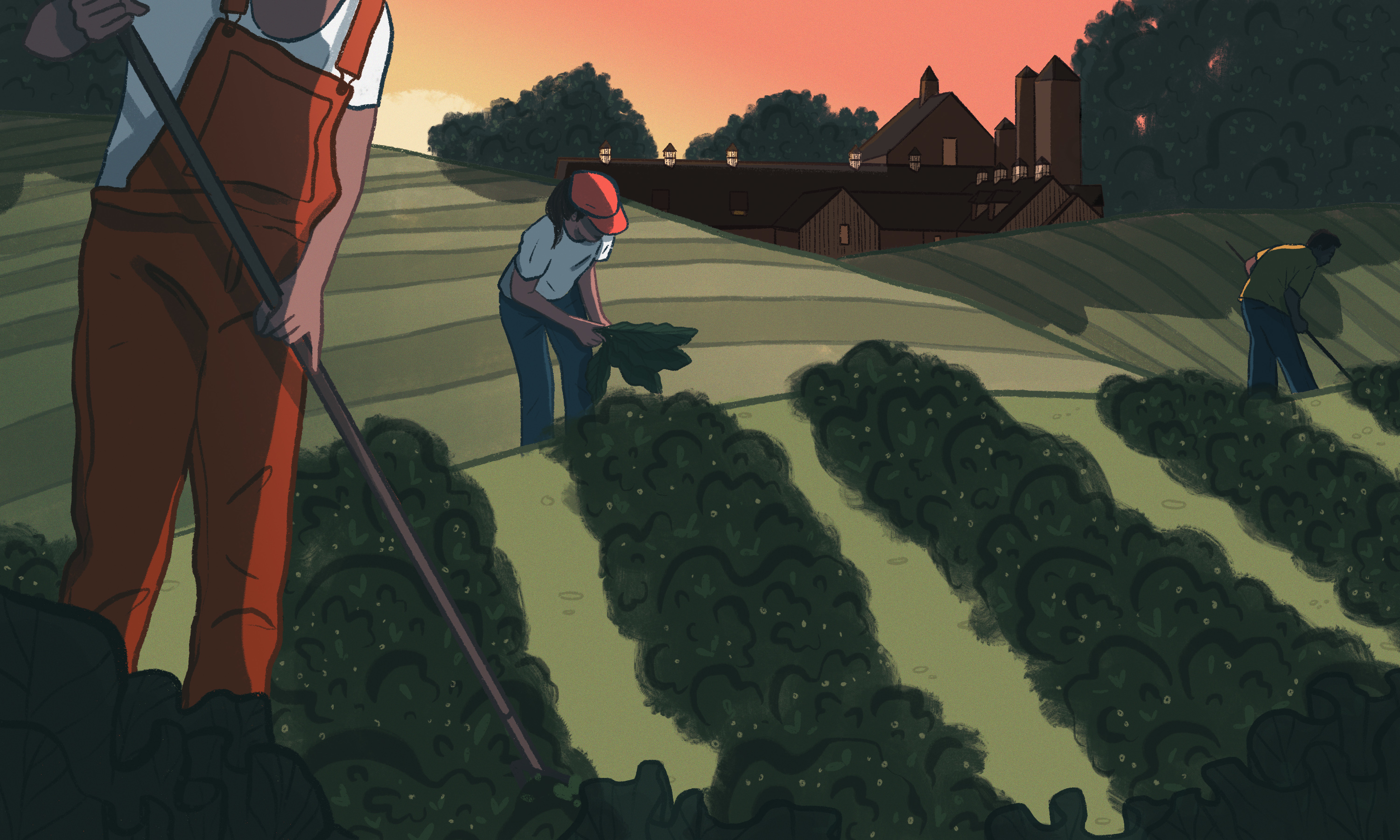
Illustration of three figures working in a field at dusk; a building in the ground casts a shadow upon the ground.

>> Part 2: Can This Farm Fix Agriculture If It Can’t Fix Itself?

Eighteen former workers at the Stone Barns Center for Food & Agriculture allege dysfunction in the livestock program at America’s most famous regenerative farm.

Meghan McCarron is Eater’s senior correspondent.
Kailey Whitman is an illustrator and designer. She likes to draw, drink coffee, and go outside, sometimes all at once.
Fact checked by Samantha Schuyler and Jasmine Liu


from Eater - All https://ift.tt/bHm5P6d

Feed the Rich, Save the Planet?

View from through a window of workers in a field around dusk. In the foreground, a hand places a plate on a table with a white tablecloth.

For 15 years, the Stone Barns Center for Food & Agriculture tried to fix the food system by educating children and producing new farmers. Now, its mission is linked more than ever to fine dining destination Blue Hill at Stone Barns and a famous chef’s vision for trickle-down change.

On the morning of February 7, 2020, office employees at the Stone Barns Center for Food & Agriculture filed one by one into meetings with management. Some came out crying. Of an office team of 17, six were laid off. Leadership gathered the remaining staff at lunchtime to process what had just happened; during the meeting, the HR director played a singing bowl, and Peggy Dulany, Stone Barns co-founder and chair of the board, burned sage.

Dulany explained that the layoffs were part of a restructuring that would launch the next phase of Stone Barns. “We need folks who are going to champion the new direction,” she reportedly said. It was not a gentle pivot. For 15 years, Stone Barns had been as much an education center as a farm, devoted to turning schoolkids into engaged “food citizens” and training young farmers. Now, it would evolve into a research and development center focused on gastronomy, hosting researchers and training culinary professionals who would entice consumers to buy more responsibly grown food.

When leadership began presenting these ideas to staff in 2019, a number of Stone Barns employees vocally disagreed with the new direction. They believed it would deepen the organization’s elitism and narrow its immediate audience. Their discomfort was magnified by the fact that one of the main architects of the plan was Dan Barber, the chef and co-owner of the on-site fine dining restaurant, Blue Hill at Stone Barns.

What followed, through the pandemic and the turmoil that it caused, was a quiet struggle for the soul of Stone Barns as the nonprofit’s work grew increasingly entwined with Barber and Blue Hill. At stake was how one of the most influential food and agricultural nonprofits in the country would use its formidable resources — more than $100 million in assets, the backing of the Rockefeller family, and an enormous public profile — to create a better food system.

Over the past year and a half, I’ve spoken with more than a dozen people with knowledge of this internal struggle, several of whom were current employees at the time we spoke. Given the pervasive influence of Stone Barns, Blue Hill, Dan Barber, and the Rockefeller family, numerous sources for this story have requested anonymity out of fear of retaliation. Pseudonyms are denoted with asterisks. Repeated requests to speak directly with the leadership of Stone Barns and Blue Hill were denied. While this series of stories was being reported, Blue Hill and its leadership — Dan Barber, David Barber, and Laureen Barber — retained the prominent Washington, D.C.-based crisis PR firm Trident DMG, as well as Clare Locke, a high-profile defamation law firm; all responses and quotations from Blue Hill and the Barbers came through a spokesperson. All responses from Stone Barns came via its own spokesperson.

“The work that Blue Hill does in connection with Stone Barns is essential to furthering Stone Barns’ charitable and educational mission,” Stone Barns said in a statement. “Stone Barns works closely with Blue Hill because Blue Hill has been a pioneer in furthering the use of regenerative farming techniques in sourcing its food and promoting mindful, informed consumption, with the goal of creating a community of eaters who understand the effects of their daily food choices.”


When David Rockefeller, the billionaire philanthropist and grandson of Standard Oil magnate John D. Rockefeller, opened the Stone Barns Center for Food & Agriculture with his daughter Peggy Dulany in 2004, the nonprofit’s mission was to “demonstrate, teach, and promote sustainable, community-based food production.” One component was the establishment of its working four-season farm. The other was outreach directed at the general public, which was vastly less familiar with the benefits of eating locally and organically than it is today — relatively few had heard of a key Stone Barns cover crop, kale, for example. The center catered particularly to children: In addition to tours of its farm, gardening workshops, and seminars about agriculture and sustainability at its 80-acre complex, it led field trips for schools and scouting groups, offered class programming that met New York State Learning Standards, and even hosted after-school programs and summer camps to educate students about where food comes from.

Stone Barns’ ambitions for educating younger generations grew from there, and in the 2010s, it began a wide-reaching program aimed at what it considered an overlooked, but essential, demographic: teenagers. It developed a semester-long curriculum for high schools called “Food Ed.” that emphasized the interconnectedness of food, the environment, nutrition, and culture, and offered free, annual training conferences for educators willing to implement it. Hundreds of teachers adopted the program, carrying Stone Barns’ message beyond its tony Pocantico Hills campus — in 2016, it noted that the “vast majority of participating students come from economically disadvantaged communities, with 72 percent qualifying for free or reduced-price school lunch.”

A man in a farmer’s hat holds up seedlings in a pasture for a group of six children. Stan Honda/AFP via Getty Images
Farm director Jack Algiere shows onion seedlings to a group of kids visiting Stone Barns in May 2005.

With a growing crisis of farmers hitting retirement age and no one to replace them, Stone Barns was also committed to educating another group of young people: the next generation of farmers. In 2008, it held the first-annual Young Farmers Conference, bringing together more than 170 early-career farmers to participate in networking events and two dozen educational workshops. Over the next few years, its Growing Farmers Initiative expanded, and its apprentice program, which aimed to teach rising farmers everything they needed to know to work on, or start, their own sustainable farms in the mold of Stone Barns, became one of the most sought-after apprenticeships in the regenerative farming world.

Within a decade of its founding, Stone Barns had become a center of high-profile conversation around sustainable farming, the food system, health, and climate change. In addition to its own conferences and initiatives, such as the Slow Tools conference, it hosted symposiums led by other influential groups, like Ferran Adrià’s Basque Culinary Center, bringing the world’s top chefs and luminaries to its campus to discuss everything from seed breeding to responsibly sustaining the global food economy.

For all of its nonprofit efforts, however, Stone Barns is one of the best-known food organizations in the country because of the Michelin-starred restaurant on its grounds. This was somewhat by design: Blue Hill at Stone Barns, led by Dan Barber, was conceived as a showcase for, and financial supporter of, the work of Stone Barns. Barber had already achieved some level of recognition for his farmer-centric approach to cooking at Blue Hill in Manhattan, but it was at Blue Hill at Stone Barns that his profile truly exploded: The partnership provided the backbone for the advocacy connecting flavor, soil health, and nutrition that made him one of the most influential chefs in America, as well as the agriculturally attuned cooking that made his restaurant one of the most celebrated in the world.

While their rise has been largely in concert, Stone Barns and Blue Hill are distinct: The Stone Barns Center for Food & Agriculture is a nonprofit organization and Blue Hill at Stone Barns is a for-profit restaurant. For most of their existence, legally and financially, the relationship between the two has essentially been landlord and tenant, buyer and seller, contractor and customer: Blue Hill paid rent and facilities fees to Stone Barns; Stone Barns sold its meat and produce to Blue Hill; Stone Barns contracted Blue Hill to cater the nonprofit’s fundraisers, run its cafeteria, and, at times, do consulting work. Barber has described it as a “transactional situation.”

A man in chef’s whites speaks at a podium in front of a display. Photo by Neilson Barnard/Getty Images for the New York Times
Dan Barber speaks at the 2015 New York Times Food for Tomorrow Conference at the Stone Barns Center for Food & Agriculture.

Barber was also relatively distant from the everyday work of Stone Barns, current and former employees say. He has always been involved at a high level — partnering with the Rockefellers at the organization’s conception, and serving on its board from 2007 to 2020 (his brother and Blue Hill co-owner, David, currently serves on it) — and will gaze into the middle distance of its fields for cameras. But numerous former Stone Barns staffers say that prior to 2019, Barber was not a particularly notable presence on the farm, in the office, or in its day-to-day fundraising operations, and that they rarely interacted with him. (Stone Barns contests Barber’s distance from its day-to-day work. “Dan and Blue Hill were integrally involved with Stone Barns programs prior to 2019,” Stone Barns said.)

In 2017, David Rockefeller died, and his estate began making a series of generous gifts to Stone Barns. In 2015 and 2016, the years immediately preceding his death, Stone Barns received about $4.5 and $4.7 million, respectively, in gifts and grants, and had assets of roughly $50 million. In 2017, Stone Barns received about $33.5 million, and in 2018, it received another $27.6 million, along with another 90 acres of land, bringing the value of its total assets above $100 million.

The windfall spurred Stone Barns leadership to reconsider how the organization accomplished its mission. In its 2018 annual report, released at the end of the year, co-founder and board chair Peggy Dulany teased that major changes lay ahead for Stone Barns and its relationship with Blue Hill: “At this moment of urgency to stem the worst effects of climate change, we are poised to scale our impact and address the greatest challenge of our time,” she wrote. “In collaboration with our partners at Blue Hill, Stone Barns Center is in the midst of a strategic planning process focused on bringing agriculture and gastronomy into [an] even closer working relationship.”


By the start of 2019, Barber, along with Stone Barns farm director Jack Algiere, had begun pitching the next phase of Stone Barns to its staff. The concept for what was dubbed “2.0” arose from the notion that changing the food system would require Stone Barns to radically “scale up the scope and impact” of its work by changing “not just what people eat, but how they eat.”

In its most complete public articulation of 2.0 — an application for the Rockefeller Foundation Food System Vision Prize — Stone Barns declared that change “is only possible when it is led by deliciousness.” Echoing what Barber has been proselytizing more than a decade, Stone Barns posited that changing the food system must start with using “flavor” to entice people to buy — for instance — bread that is baked by artisans who work with craft millers who make flour from whole grains grown by local farmers using seeds that were bred for flavor and nutrition. This “networked, circular” system would bridge the gap that persists between consumers and farmers, creating a robust economy centered around foods sustainably produced by local farms and other links in the regional food supply chain.

To realize this expansive vision of an “ecological food culture,” Stone Barns 2.0 would be organized into a series of labs. While some of them retain Stone Barns’ historical focus on agriculture, such as seed breeding, a majority would be devoted to gastronomic topics, including baking, meat processing, milling, and preservation. At these labs, researchers might devise innovative whole-animal butchery techniques to maximize an animal’s “culinary potential,” then train butchers in Stone Barns’ methods and philosophies. Through their connection to Stone Barns, those butchers might then find farmers raising grass-fed beef to supply them. Stone Barns would share the results of research with farmers, academics, and “culinary artisans” through its “broadcast lab,” from which it would also drive consumer demand for sustainably produced food with compelling stories about ingredients, farmers, and artisans told through podcasts, newsletters, and media appearances.

A serving of risotto made with different grains, shot from above. Neilson Barnard/Getty Images for the New York Times
Dan Barber’s rotation risotto “capture[d] minds and taste buds across the Hudson Valley and the globe,” according to Stone Barns.

The 2.0 model predicts that access to this better food culture and its healthier, more delicious products will quite literally trickle down: It argues that as consumer demand grows for grass-fed beef and whole grains, infrastructure will be built alongside that demand, advocacy will result in public policy more favorable to small farms and producers, prices will come down, and, eventually, “the inequalities baked into a system in which healthy whole foods are only available to those with significant disposable income” will be left behind.

The aspirations of 2.0 would be manifested in part by deepening the relationship between Stone Barns and Blue Hill: Blue Hill staffers would guide some of the culinary labs, while the restaurant would serve as a real-world test bed for their research. Close partnerships between for-profit and nonprofit institutions are not uncommon. A nonprofit that wants to increase its impact, but has a limited budget, can partner with a for-profit business to accomplish a shared goal. For example, a housing nonprofit may choose to partner with a for-profit developer to complete a one-off building project. And under Barber’s leadership, Blue Hill at Stone Barns had become internationally known for creating a market for responsibly grown food.

The 2.0 presentations received pushback from a group of Stone Barns employees who were less convinced that gastronomic R&D in concert with Blue Hill was the best way to maximize the nonprofit’s newfound resources. For one, the Barbers, as co-owners of Blue Hill with David’s wife Laureen, had a vested interest in a closer partnership between the restaurant and the nonprofit. For another, Blue Hill already, quite famously, spearheaded some of the culinary research that the labs would tackle, such as producing a more-delicious whole-grain bread.

According to the Barbers’ spokesperson, Dan and David recused themselves from any Stone Barns board discussions pertaining to Blue Hill, and Stone Barns farm director Jack Algiere was equally involved in the conception of 2.0. “By formalizing the relationship [with Blue Hill] ... the work that was previously exclusively in the kitchen and for diners becomes accessible to a broader audience, and we are able to welcome not just the public but experts, researchers, scholars, and artisans to participate in the innovation,” a spokesperson for Stone Barns said. “The ultimate decisions about the Stones Barns Center’s mission and how to implement that mission is and always has remained firmly and completely in the hands of the Stone Barns Center Board and management.”

Three workers in a field in the foreground, with restored stone barns in the background. Stan Honda/AFP via Getty Images
Workers plant crops in view of the main complex at the Stone Barns Center for Food & Agriculture in 2005.

Most of all, however, staffers’ concern about elitism in their institution, its halting efforts to address the whiteness of its leadership, the relatively narrow demographics of its primary audience, and its overlooking some vast inequalities in the food system had grown profound in recent years. “Our leadership is super hierarchical, all white, very wealthy,” says Taylor*, who was a current Stone Barns employee when we spoke and requested anonymity. “A lot of our visitors were locals, people who could afford to come to programs and, given our location, people from the same socioeconomic background as a lot of diners [at Blue Hill].”

Those issues had been vividly crystalized for staffers in the summer of 2017 during Stone Barns’ inaugural Exchange Fellowship, which included a three-week residency, intended to promote the sharing of ideas across disciplines. One of those first fellows was the writer and activist Shakirah Simley, who in the wake of the 2016 election had co-founded an organizing collaborative called Nourish|Resist. She says that during her three-week residency she encountered, over and over again, the organization’s profound failure to interrogate who, exactly, it was changing the food system for. Simley and another fellow of color, the chef Yana Gilbuena, describe repeatedly encountering storytelling by Stone Barns and Barber that they believed erased or ignored people of color from their grand vision of a new food system. They challenged the organization to do better, culminating in a presentation to 400 people at the Young Farmers Conference that December.

A public call to accountability hadn’t been the plan. But the evening before, during a Q&A following his keynote speech, Mark Bittman, the renowned food writer turned public health advocate, had responded to chef and educator Nadine Nelson’s question about accountability in a manner viewed by a number of other attendees as dismissive. (Bittman later apologized on Twitter.) When Stone Barns initially failed to directly address the incident, Simley, Gilbuena, and two other fellows tore up their planned presentation in order to make sure the conference engaged with what had happened. “These microaggressions — silencing, shaming, sweeping things under the rug — they happen in dining rooms, kitchens, in fields, and they happen within nonprofit organizations,” Simley said in her presentation. In the aftermath of the very public calling out, Stone Barns hired a consultant and undertook some DEI work, but several former employees say that the changes needed to be much more dramatic.

And now, as Stone Barns was preparing for a dramatic transformation, those concerns remained among staff. While documentation pertaining to 2.0 would acknowledge that “the local ‘farm to table’ movement originate[s] in indigenous, African, and immigrant traditions” and that Stone Barns had not done “enough to conduct our work in solidarity with communities of color,” in the view of some staff, the plans they were presented with failed to meaningfully address racial or social justice in the food system in any immediate way; they appeared to, at least initially, primarily benefit the culinary and dining elite, much like existing fine dining R&D programs such as Noma’s famed Fermentation Lab.

In response, employees proposed that “democratizing the food system” become a core plank of 2.0 as internal debates about the plan continued into 2020. It did not. (“A generalized ‘plank’ isn’t needed because this idea is infused into the very core of the 2.0 vision,” Stone Barns said in a statement. “The vision of 2.0 is to democratize the food system through connecting regional networks of stakeholders.”)

Lauren Yarmuth, who was hired as the new executive director in the fall of 2019, appeared open to these staff concerns, and spoke about wanting to break down hierarchies within the organization as well. Going into 2020, few at Stone Barns knew what the actual nitty-gritty of 2.0 would entail, but some of the employees who spoke for this story describe themselves as more hopeful under Yarmuth’s leadership. By April 2020, she would be gone, and Stone Barns staffers would be reporting directly to the owners and top management at Blue Hill.


The arrival of the COVID-19 pandemic accelerated how quickly, and thoroughly, Blue Hill and Stone Barns became “joined at the hip,” as Barber later put it. In mid-March, like the rest of the restaurant industry, Blue Hill shut down its dining room and laid off most of the staff. On April 10, it received a Paycheck Protection Program loan for more than $2 million. Under the program’s guidelines for loan forgiveness, the restaurant needed to use at least 60 percent of the loan for payroll.

That same day, Peggy Dulany sent an email to Stone Barns staff announcing that the organization was “formally implementing” an initiative called “resourcED.” Described as “a plan to preserve the Stone Barns farm and other farms” by providing schoolchildren, front-line workers, and members of the Stone Barns community “with healthy, delicious food,” she wrote that this program would mark the first “joint collaboration” between Stone Barns and Blue Hill, and serve as a “great launching pad” for 2.0.

Barber has described himself at this time as being driven by, “Fear, fear, fear. Fear of failure.” Specifically, the fear of suffering another brutal restaurant closure, like one that had shaped his early career, or of his staff losing their jobs. The joint program, he has said he realized, “is my path out of not failing.”

Illustration of a person in a chef’s apron pulling back a curtain printed with the image of a building.

Even Stone Barns staffers who thought 2.0 could potentially have a positive impact on their mission told me that they were concerned by how quickly and thoroughly Stone Barns leadership routed its pandemic response through Barber and Blue Hill. These concerns began with ResourcED, which Blue Hill was hired to develop and execute by Stone Barns. ResourcED comprised a number of initiatives, but its main offering was “a series of food and farm boxes” prepared by Blue Hill staff and made with products from Stone Barns and other local farms. Most were sold directly to consumers, who could also pay for donation boxes that went to local hospitals and community organizations.

Essentially, Stone Barns was contracting out its pandemic response to the restaurant. (Multiple Blue Hill employees who worked on resourcED told me that they didn’t even realize it was a Stone Barns program.) To fully support Blue Hill’s work on resourcED, Stone Barns paused all other programs, and did not attempt to offer pandemic-friendly versions of their ongoing work, such as virtual training for farmers and teachers. Stone Barns staffers say that the farm was also required to sell all of its produce to Blue Hill, including vegetables that already had outlets in the farm’s existing CSA — one of its only direct-to-consumer sales channels — at a moment when demand for CSAs was exploding nationwide.

Riley*, a current Stone Barns employee, says that reasons for outsourcing the nonprofit’s pandemic response to Blue Hill were never made clear to staff, and in Riley’s opinion, it was not to the benefit of Stone Barns’ mission. “We’re subsidizing this restaurant during this pandemic because it’s the Dan Show,” they say.

According to the Stone Barns Center’s 2020 990 filing — the primary IRS form used by nonprofits, which are required to be made public — that year, the nonprofit paid Blue Hill or otherwise financially aided the restaurant in a number of ways. Some of this was common throughout the restaurant industry, as owners with empty dining rooms cut deals with their landlords — Blue Hill paid Stone Barns $179,100 in rental fees in 2020, down from $1,231,553 in 2019. It also received a $250,000 grant to support resourcED. The restaurant was paid $1,215,502 in contractor fees running the resourcED program, compared to $263,333 in 2019, and just $37,500 paid between 2016 and 2018, before 2.0 began. (The restaurant also paid Stone Barns nearly twice as much for farm purchases in 2020 than 2019, by about $400,000. “Blue Hill did not profit in any way from these programs,” a Blue Hill spokesperson said.)

ResourcED wound down in the fall of 2020, with Stone Barns announcing that it had spent $445,000 on local farms, encouraged 4,000 people to plant gardens, and donated more than 7,000 meals. In a statement, Stone Barns said that it turned to Blue Hill to develop and manage the program because its board “felt that leveraging the existing infrastructural resources of Blue Hill to provide disaster aid” made the most sense. (For instance, as essential workers, Blue Hill’s restaurant employees could work on campus to pack boxes, while Stone Barns’ office staff could not.) Stone Barns also said that its board “closely reviewed [resourcED] at inception to ensure its overall consistency with Stone Barns’ charitable and educational purposes and to guard against impermissible private benefit.”

Part of the cost of supporting Blue Hill through the pandemic, multiple former Stone Barns employees say, was damage to their organizational culture. Blue Hill’s leadership — Dan Barber, his brother David, sister-in-law Laureen, and then-vice president Irene Hamburger — directly supervised members of Stone Barns staff during resourcED. Under their management, current and former staffers say, there was yelling and public humiliation at Stone Barns, reminiscent of the alleged culture in the Blue Hill at Stone Barns kitchen. “There was a cultural shift from Blue Hill leadership culture, and it’s a very aggressive, extreme, putting-in-your-place tone,” Taylor says.

“We went from working at a nice little nonprofit to working at a restaurant,” says another former Stone Barns employee.

“The working culture at Blue Hill is generally different and more intense than that at Stone Barns. Whether one culture is better than another is subjective,” a spokesperson for the Barbers said. “Dan is aware of one Blue Hill employee who raised her voice at both Blue Hill and Stone Barns staff at that time. He disciplined the employee as soon as he heard about it.”

Capping Stone Barns employees’ frustrations, that summer, staff who made above a certain salary at both the office and farm sides of Stone Barns were asked to take pay cuts, which was later framed as a step taken in “solidarity” with Blue Hill. The financial rationale was never explained, multiple former employees say, and it was mystifying to them why a nonprofit with assets of more than $100 million needed to cut into its employees’ salaries, even temporarily.


The skeleton crew of cooks called back to Blue Hill to assemble the resourcED boxes discovered an unexpected perk: After years of working together, they were finally getting to know their coworkers. “We didn’t have service, didn’t have 14-hour shifts, we weren’t constantly running around, we weren’t being yelled at,” says Emma Meigneux, a cook who worked on the food box assembly program. As they started talking, they realized many things they’d struggled with individually at the restaurant were actually problems many of them shared. They also realized that it might be an opportune time to speak out.

In the aftermath of George Floyd’s murder in May 2020, the social media backlash that swept across the culture came for Barber, Blue Hill, and Stone Barns. In late May, Barber called for cooks to storm Battery Park under the cover of night and plant vegetables; his Instagram post was criticized both for its joke about daring the police to retaliate, and for erasing the work of Amber Tamm, a Black farmer and activist who had been advocating for urban farms, including a project of her own in Central Park. (A representative for Barber said, “Dan took these criticisms to heart. He had not known of Amber or her work before, he spoke with Amber multiple times, and she helped him realize that part of his project’s success was due to white privilege.”)

Another ResourcED initiative masterminded by Barber, Harvest Corps, involved sending laid-off cooks to work for free on organic farms, and specifically invited BIPOC cooks to apply; it was compared by commenters to slavery. (“Harvest Corps offered educational opportunities to culinary students and unemployed cooks while helping small farms in need,” Barber’s spokesperson said. “It is false to report that the program ‘was geared toward’ cooks of color. But, we were certainly working hard to attract members of the BIPOC community to make the program more inclusive and diverse. Accordingly, BIPOC students and out-of-work cooks were encouraged to apply for scholarships to cover travel and insurance costs. Every volunteer received room and board, including three meals per day.”)

A stone building is surrounded by a field and woods. Cole Wilson/Bloomberg via Getty Images
An exterior view of Blue Hill at Stone Barns in Pocantico Hills in 2017.

The pushback Barber received on social media — an arena where he was usually showered with likes and comments of “oui chef!” — caught the attention of a group of Blue Hill at Stone Barns cooks, as well as recently laid-off front-of-house staff, who decided to write a letter to management. The letter’s demands included raising wages at Blue Hill at Stone Barns to the New York City minimum wage of $15 an hour; compensating interns and stages beyond free housing; expanding trainings to address issues of racism and sexism in the workplace; and diversifying the restaurant’s executive ranks. “We just wanted to talk about the underlying sexism and racism and how we wanted Blue Hill to address it and find professionals to help systemically change the business,” Trang Tran, who was a baker at Blue Hill between 2018 and 2020, told me.

There were smaller cultural critiques, too: Former Blue Hill cooks say that they were sent out to speak to guests from their own ethnic background, such as a Japanese cook being sent to speak to Japanese guests, and the letter asked that this labor be recognized and rewarded. Blue Hill cooks understood less about the overall 2.0 plan than Stone Barns staff, but they knew the restaurant was planning changes, and urged leadership to address social justice more directly. The letter proffers a list of potential policies to implement as the restaurant transitioned, including buying from more BIPOC producers, helping Black farmers find larger markets for their goods, and donating food to mutual aid and food banks.

The George Floyd uprisings sparked action by Stone Barns staff, too. On June 2, black squares covered Instagram, and Stone Barns took part in the meme. The comments were blistering. “Put your money where your words are, Stone Barns!” wrote a Black farmer named Dare Arowe, who had been accepted into the Stone Barns 2020 apprenticeship class. But when she asked for financial assistance for the move to Westchester, the organization declined. When the black squares appeared, Arowe was fed up. “I was like, let’s start this fucking conversation,” she says. (“The inherent inequities in the apprentice program is one of the reasons we ended the program,” Stone Barns said.)

Stone Barns staff also decided to write a letter urging their organization to take up the cause of social justice. The letter from Stone Barns’ administrative staff and farmers was sent to the Center’s board, with the subject line “A Heartfelt Request.” In it, the staff demanded that Stone Barns move toward becoming an “anti-racist” organization, and to do substantive work to change the culture of the nonprofit until it could truly address the racial injustices embedded in the food system.

The Blue Hill letter received two replies from Barber and the management, which broadly agreed with the issues raised, and promised to review training, hiring practices, and sourcing practices to make them more inclusive. Dulany, as chair of the Stone Barns board, replied to the Stone Barns letter promising to do better on the grounds of racial justice.

The Blue Hill staff behind the letter had hoped for a more substantive conversation. “I think we were very naive in thinking that we could just have a meeting with everyone to discuss why this was written and what we want to see from the company,” Tran says. “That didn’t happen.”

“Blue Hill worked hard on the issues the staff raised,” the restaurant said in a statement that detailed its efforts in employee training and hiring practices, equity and transparency, and “culinary work grounded in an anti-racist lens.” Stone Barns said that it “is committed to diversity in all its forms and has taken concerted action to address the issue. Dating back to at least 2018, we hosted trainings, workshops, and formed a DEI committee which met to address shortcomings.”

Trang and others who worked on the Blue Hill letter say they were unaware of any of these new DEI initiatives as they were being developed. Instead, in the days and weeks after sending the letter, they went back to work.


About a month after the Blue Hill staffers presented their letter, the New York Times reported that Dan Barber would “step away from kitchen duties” and Blue Hill New York and Blue Hill at Stone Barns would both close through at least 2021. Blue Hill at Stone Barns would be replaced by Chef in Residence at Stone Barns, which would host a rotating cast of visiting chefs. Barber told the Times the program’s inspiration came in part from his staff, who had been “pushing some of the issues” that summer. (The Blue Hill staffers who spoke for this story and contributed to the original letter say that they were not involved in conceiving the Chef in Residence program in any way, and that its announcement came as a shock.)

The Chef in Residence series marked the second and more elaborate phase of Stone Barns’ partnership with Blue Hill. In the run-up, Stone Barns announced in November 2020 that four former Blue Hill employees, including VP Irene Hamburger, the restaurant’s HR director, its director of facilities, and one of its event planners, would move into a number of key positions at Stone Barns — all in addition to the multiple kitchen staffers consulting on the Stone Barns culinary labs. And despite publicly stepping away from Blue Hill, Barber and his team helped select the chefs for the residency, worked with them at the culinary labs, celebrated them on Instagram, and chatted up critics who happened to come to dine.

The residency launched in January 2021, and would ultimately feature nine chefs, including Omar Tate, Victoria Blamey, and Bryan Furman, each helming the Blue Hill at Stone Barns kitchen for a month. The reception to the dinners, which cost between $75 and $225 per person, was overwhelmingly positive.

A man in chef’s whites stands in front of a screen displaying vegetables. Neilson Barnard/Getty Images for the New York Times
Dan Barber onstage at the New York Times Food for Tomorrow conference in 2015.

As the Instagram accounts that came under so much fire over the summer of 2020 — Barber’s, Blue Hill’s, and Stone Barns’ — filled up with photos of Black and brown chefs cooking their own food and demonstrating the same passion for ingredients that Barber had performed for so long, Barber and Blue Hill became one of the few restaurants to have a visible response in the wake of the George Floyd protests; former Blue Hill and Stone Barns staffers who were critical of their time there praised the diversity of the dinners. “It definitely shared resources and a platform with chefs of color and also female chefs,” Taylor says.

Chef in Residence became Stone Barns’ primary initiative for 2021, so it included charitable and educational components: During the first season, guest chefs designed “family meals” that were donated to a number of organizations on a weekly basis, including Open Door Family Medical Center, Mixteca, and Rockland Pride Center. Each chef in residence also spent time working with the culinary labs, while public programming for the residency, meant as a companion to the dinners, “included virtual education, conversations, cooking classes, and much more” led by the chefs, as well as dozens of other guest speakers, by the time the residency ended in summer 2021.

But current and former Stone Barns employees had serious doubts about the reach and impact of Chef in Residence, particularly with regard to education. The guest chef talks were only open to staff, ticketed diners, and Stone Barns members — supporters who paid an annual fee for various perks — for the first six months of the program, and even after they became accessible to the public online, viewership and engagement was low, according to multiple current and former Stone Barns staffers. As a result, most of the education, they say, went to Blue Hill staff, who worked closely with the guest chefs and regularly attended their talks — meaning that the majority of the series’ public audience were the paying dinner guests. “With the exception of a few donated meals once a week, the amount of people who were actually impacted — truly impacted, not just ‘I signed in for a 20-minute virtual Zoom’ or ‘I’m a chef and it’s my job and I went to my mandatory cook’s meeting’ — are the diners,” says Riley. “And what is that person doing with that information?”

Part of staffers’ discomfort with the scale of the impact was the program’s substantial cost, and how it was paid for. Stone Barns’ budget for 2021 was $10 million; each four-month “season” of Chef in Residence cost roughly $2 million to produce. Tickets to the sold-out dinners did not fully cover their cost, so Stone Barns led a dedicated round of fundraising for Chef in Residence — much of which was paid to Blue Hill, which had once again been contracted to run the culinary aspect of Stone Barns’ programming.

Even though Barber visibly participated in fundraising — and according to Blue Hill’s spokesperson, “raised millions of dollars” to support Chef in Residence — the flow of money from the nonprofit to the restaurant left an increasingly sour taste in the mouth of some Stone Barns staffers as their concerns deepened about the impact of the organization’s new direction. “We were asking people to subsidize programs that have no impact and is going to run this for-profit restaurant,” Riley says. “That money wasn’t going to feeding community or providing education programs to hundreds of people. It’s going to paying chefs’ salaries and buying ingredients for a program that is 99 percent white-tablecloth experience.”

Stone Barns said that Chef in Residence was “highly successful in promoting our mission to broad audiences.” It also said that it was successful “as a charitable and educational initiative ... The program was designed to combat some of the racial and gender inequities in the kitchen by giving chefs from these underrepresented communities a platform at one of the top-rated restaurants in the world and to provide a means of educating others about their food culture and traditions.”

Some of Stone Barns’ farmers, who were still in the fields growing food and caring for animals during the pandemic, also felt disconnected from the dinner series; former farmers say they had little contact with the visiting chefs, especially compared to Blue Hill staff. For instance, Victoria Blamey’s stint led to “three extended research projects on kelp’s effect on soil, animal health, and the culinary applications” at Stone Barns, according to the organization, but it was Blue Hill cooks who took a field trip to the Maine coast with her, documented on the restaurant’s Instagram page. (“This trip was initiated independently by Victoria Blamey and was not organized or supported by Blue Hill or Stone Barns,” Stone Barns said.)

Partly as a result of that disconnect, farmers I spoke with also expressed frustration about how much money they perceived to be going to Blue Hill as a contractor versus to the farm. The purported $2 million cost for each four-month season of Chef in Residence is equivalent to the farm’s entire 2021 budget. The apparent discrepancy was thrown into stark relief by a freeze on infrastructure spending that meant requests for new equipment on the farm were rejected at the time. “I couldn’t get $10,000 for equipment that would make things a lot more efficient and safer,” one former farm manager told me. “They put $1.5 million into a residency.”

“Department budgets are created annually in collaboration with the department director, the director’s team (in this case, the Livestock team), accounting, and the Board finance committee,” Stone Barns said. “The annual budget includes significant room for flexibility due to equipment repairs and maintenance.”


Blue Hill at Stone Barns returned in the fall of 2021 with Barber once more at the helm. The official Instagram account celebrated the reopening by posting images of cooks and servers overlaid with their reflections on what the Chef in Residence program meant to them. “When you’re in the weeds, it can be really hard to get into that [positive] mindset,” reads a post featuring a line cook named Musashi Osaki. “But it’s so necessary to be deliberate about this attitude. As Blue Hill at Stone Barns reopens and I’m working through a mile-long prep list, I remind myself to stay focused, yes, but also to cook with joy.”

Earlier this year, Barber described the new relationship between Blue Hill and Stone Barns as “kind of a model maybe for the future of restaurants.” Blue Hill is now “sixty percent restaurant,” with what he says is a far less punishing schedule for its employees. The other 40 percent of the restaurant’s time, he said, was taken up by culinary R&D for Stone Barns. “The center is paying us to do this research and development and to run these education programs to the public, and to partners, and to disenfranchised communities who are partaking in all this research and education,” he said. A meal at Blue Hill at Stone Barns now begins with “an exploration of the property guided by cooks and farmers to serve as an introduction to our most exciting work.” Dinner, which cost $258 before the pandemic halted service in March 2020, now costs between $358 and $398 per person.

Two people walk through a wooden structure Neilson Barnard/Getty Images for the New York Times

This summer, Stone Barns rolled out a new slate of programs designed to showcase its lab and conservation work. These include guided hikes both in the mornings and at night, tours of the innovation labs, a flower-arranging class, and several culinary offerings, like a cafeteria lunch tray or a vegetable tasting of new breed trials. Tickets to every type of Stone Barns experience are sold via Tock, a reservation platform used by high-end restaurants. Meals by Blue Hill staff are on offer, too, including a pizza night where tickets start at $125.

The programming page notes that these “experiences,” which emphasize access to the Stone Barns grounds, are almost always designed with adults in mind, while the classroom-reaching Food Ed. program, “including any work with teacher training and classroom support [is] on hold for the foreseeable future.” In a statement, Stone Barns said, “there are many organizations working on school education and we felt we could add value as a place-based organization by pivoting away from a broad range of programs to do deeper work with researchers, farmers, and other partners.”

When confronted in the press about the elitism of his project, Barber maintains that changes in our diets can trickle down from high-end chefs, and paraphrases Michael Pollan’s argument that major political changes in American life can stem from elites. But Blue Hill’s appeal to its well-heeled guests is inherently a romantic one, as is the vision for Stone Barns 2.0, by training food artisans to mill the heritage grain, butcher the grass-fed cow, and preserve the experimental beets. It sounds like a lovely means of restoring enervated food traditions. But it’s not innovation: The wealthy seeking salvation in the humble authenticity of rural life has a millennia-old history in Western culture.

Of course, addressing centuries of racial injustice, or tackling the growing horrors of climate change, are large, ugly, and maybe even overwhelming problems. They’re not pleasant to think about, especially for people with the means to donate to nonprofits, who may feel implicated by these problems, rather than galvanized. It’s much easier to garner support for a legion of artisans laboring to make you a delicious, healthy meal, which could lead to changes for people in need, someday, further down the road. On the podcast Time Sensitive, Barber said, “I’ve got to raise money, so I’m out there fundraising, which is storytelling. That’s all there is. I just got through telling about facts, but fact is, we’re in a post-truth world, aren’t we? Facts don’t matter. There’s only stories, that’s it. So that’s what I do.”

Meghan McCarron is Eater’s senior correspondent.
Kailey Whitman is an illustrator and designer. She likes to draw, drink coffee, and go outside, sometimes all at once.
Fact checked by Samantha Schuyler and Jasmine Liu


from Eater - All https://ift.tt/TBLn9d5

Social Media’s Coolest Bakers Are Going All in on Fruity, Floral Dome Cakes

Kassie Mendieta/I Bake Mistakes

Whimsical yet organic, these rounded confections are a treat to behold

A cake from the Chicago-based baker Dream Cake Test Kitchen looks like something out of a Dr. Seuss landscape: Flowers poke out like Truffula trees, and halved fruit protrudes like glowing orbs. “I like to create environments that you think you saw, but you’re not sure where,” says Hyun Jung Jun, an artist who has made cakes under the Dream Cake name since 2020. “It’s kind of like, Maybe I’ve seen this place in my dreams.”

A crucial part of that Seussian nature is the shape: One of Jun’s signature designs is a domed cake. This started out of necessity when a friend requested a cake with “90 percent cream,” making a dome the most logical option, but the shape stuck because Jun liked the “soft feelings that dome cakes have.” She’s described the dome cakes she’s made ever since, covered in buttercream or mirror glaze, as fairy hills, violet bonbon islands, and creamy mountains. These cakes feel distinctly natural — adorned with evergreen sprigs and pristine fruit, they’re very much part of the popular “organic cakes” aesthetic — while also whimsical. “I like the imagination coming out of the scene,” Jun says. “What could happen here?”

Jun’s versions are their own microworlds, but riffs on the dome cake are increasingly showing up on my social feeds. Dome cakes from Bronwen Wyatt’s Bayou Saint Cake — a trendsetter in the naturalist cake niche — are swooped with her signature frosting squiggles. At Julia Gallay’s Gallz Provisions, dome cakes are more heavily adorned with flowers and fruit. Every inch covered with butterflies and tie-dye-esque frosting, the ultra maximalist versions from Ginger Mayo’s Gigi’s Little Kitchen are dream worlds for fairies on acid. Los Angeles-based baker Kassie Mendieta is calling her approach to domes “chaotic whimsy,” veering from monochromatic ruffles to a creation covered in pink strawberry shortbread crumbles reminiscent of the ice cream bar. Rose Wilde added towering beehive cakes — tall cakes topped with domes — to the menu of her microbakery Red Bread in May.

The dome cake isn’t exactly new. Sweden’s traditional, green marzipan-covered prinsesstÃ¥rta, or princess cake, is classically shaped like a dome, as is Baked Alaska, which has gotten renewed attention recently. And doll cakes, before being impaled with doll torsos, are also notably domed. Yet the shape is definitely experiencing a surge of interest.

Fun to look at, the shape is also fun to make, says Mendieta, who started making dome cakes about a month ago and posts videos of her cake-making process on TikTok. While hemisphere cake pans are available, she likes to bake her cake layers separately, build them into a domed pan, and then chill the cake overnight before flipping it. It’s the decorating part that really draws her to the dome. Not only is there more surface area, but it’s also all essentially a top-view, she explains, causing her less anxiety about messing up the sides of the cake. “It feels a lot more free in the decorative process of it all,” she says.

 Kassie Mendieta/I Bake Mistakes

There’s an obvious sense of similarity and shared inspiration within these cakes, but each is distinct enough so each baker’s personal style shines through. The dome cake trend thus ends up as something of a collective project, in which citing inspiration is encouraged. While some social media food trends become so big that they outgrow any particular niche (the viral feta pasta, for example), the dome cake still seems tethered to a sense of small community.

For Mendieta, dome cakes have been an undeniable hit. “They sell better,” she says. “But also, they’re the better performing pieces of content that I put out.” While videos of her classic cakes might nab a few thousand views each on TikTok, a recent run of dome cake videos is raking in views in the tens of thousands and up to a million. Part of this interest might be novelty, but according to Mendieta, there’s also the pull of nostalgia.

In her comments, people point to a Betty Crocker product known as the Bake n’ Fill, which created a domed cake with ice cream or Jell-O at its core and was marketed in the early 2000s. Today, the top comment on a Bake n’ Fill infomercial on YouTube says, “I remember being 10 years old, wanting this so bad.” Cracked published an ode to the Bake n’ Fill last year, attributing fondness for the product to its opportune timing for millennials who were watching a lot of TV. This kind of callback makes sense to Mendieta. “Everyone’s into Y2K fashion, and I think it’s becoming the same for food trends as well,” she says.

While the dome cake might be tapping into some deep-seated childhood fantasy, one thing is certain: The dome cakes of today are dreamier than anything that Betty Crocker infomercial ever put forth.


from Eater - All https://ift.tt/jMh0AFm

Popular Posts